
5 Signs Your Application Needs a Custom Laser Solution
October 5, 2026
Applications
5 Signs Your Application Needs a Custom Laser Solution
Standard, off-the-shelf laser modules can sometimes meet a customer’s needs when their optical, mechanical, and electrical specifications align with the requirements of the application. However, many OEM and industrial systems have requirements that do not fit neatly within the specifications of an existing product. Working distance, beam geometry, wavelength, packaging, performance consistency, and system integration can all influence whether a standard module is the right choice.
A custom laser module provides an opportunity to design the laser around the application rather than forcing the application to accommodate the limitations of an existing product. For OEM developers and system integrators, customization can address specific optical and mechanical requirements while also supporting repeatable manufacturing and long-term product performance. Here are five common signs that a custom laser module may be worth considering.
1. The Application Requires a Specific Beam Geometry
Laser beam geometry is often one of the first indicators that a standard module may not provide the performance an application requires. A standard module may produce the correct general type of beam, but its spot size, line width, fan angle, focus position, or beam divergence may not be optimized for the required working distance.
For example, a machine vision system may require a narrow laser line at a specific distance from the laser source, while a standard line laser may produce a line that is too wide or has the wrong geometry at that location. Similarly, a precision measurement application may require a small focused spot at a defined working distance that is not available from a standard module.
Custom optical design can allow the beam geometry to be developed around the application’s actual operating conditions.
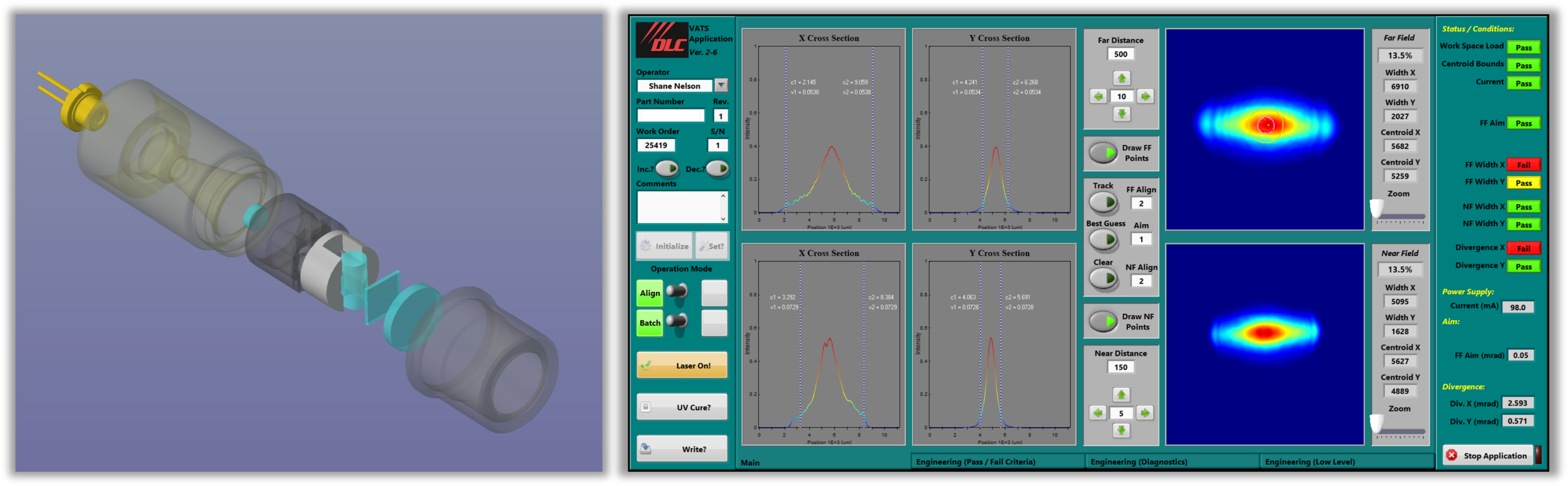
Laser beam geometry can be optimized for a defined working distance, spot size, line width, fan angle, or power uniformity.
Application-specific spot size and beam waist
Defined laser line width at a specified working distance
Custom fan angle and field coverage
Optimized focus position and beam divergence
Optical design tailored to the customer’s measurement or inspection requirements
2. The Standard Wavelength Doesn’t Work for the Application
The laser wavelength can have a significant effect on how a system interacts with the target material and how effectively the resulting signal can be detected. Surface reflectivity, material properties, detector sensitivity, ambient illumination, and other system characteristics may make one wavelength more suitable than another.
An off-the-shelf module may be available in several common wavelengths, but the best wavelength for a particular application may not be one of the standard choices. In other cases, the required wavelength may need to be combined with a specific beam geometry or optical package that is not available as a standard product.
A custom laser module can be designed around the wavelength and optical characteristics required by the complete system rather than selecting the application around an existing module.

Laser wavelength selection can be tailored to the target material, detector, and application requirements.
Wavelength selection based on target material and optical response
Compatibility with application-specific detectors and imaging systems
Consideration of ambient-light and background conditions
Integration of wavelength requirements with custom beam geometry
Specialized wavelength and optical configurations for OEM applications
3. The Mechanical Package Doesn’t Fit the System
In many OEM applications, available space is limited and the laser must integrate into an existing mechanical architecture. A standard module may have the required optical performance but still be unsuitable because of its overall dimensions, mounting configuration, connector location, heat-management requirements, or other mechanical constraints.
Rather than redesigning the customer’s system around a standard laser package, a custom module can be designed to fit the available space and interface requirements. Mechanical packaging can be developed alongside the optical design to ensure that the laser can be integrated into the intended system.
For applications where precise optical positioning is critical, DLC can also develop the opto-mechanical mounting and alignment strategy around a defined mechanical reference. Optical performance is actively aligned to that reference during manufacturing using application-specific alignment hardware and optical metrology.
This allows the completed laser assembly to be installed into the customer’s system with the optical alignment already established—effectively making the laser a plug-and-play component rather than an assembly that requires field alignment.

Custom laser packaging can accommodate application-specific space, mounting, and integration requirements.
Application-specific module dimensions and form factors
Custom mounting features and mechanical interfaces
Optical alignment referenced to defined mechanical datums
Highly repeatable opto-mechanical mounting and alignment
Connector and cable placement tailored to system requirements
Plug-and-play installation without field optical re-alignment
Integration of optical, mechanical, and electrical requirements
4. Unit-to-Unit Consistency Is Critical
For an OEM system, designing one laser that performs well is only part of the challenge. The laser must continue to perform consistently as additional units are manufactured and integrated into production equipment.
Variations in beam position, focus, line width, pointing, optical power, or other characteristics can affect the performance of the larger system. This can become especially important when the laser is being used for precision measurement, machine vision, alignment, or automated inspection.
Custom laser development can incorporate application-specific alignment procedures, optical metrology, process controls, and production testing to establish repeatable manufacturing outcomes. The result is not simply a laser designed to meet the requirements of one prototype, but a manufacturing process designed to reproduce the required performance across production units.
A critical part of this approach is establishing a repeatable relationship between the laser’s optical performance and its mechanical mounting reference. DLC has extensive experience developing custom opto-mechanical fixtures, alignment hardware, and metrology systems that allow optical characteristics to be precisely aligned to defined mechanical references during manufacturing. This approach enables the optical alignment established during production to be reproduced from unit to unit, allowing replacement or production modules to install into the customer’s system without requiring additional optical alignment.
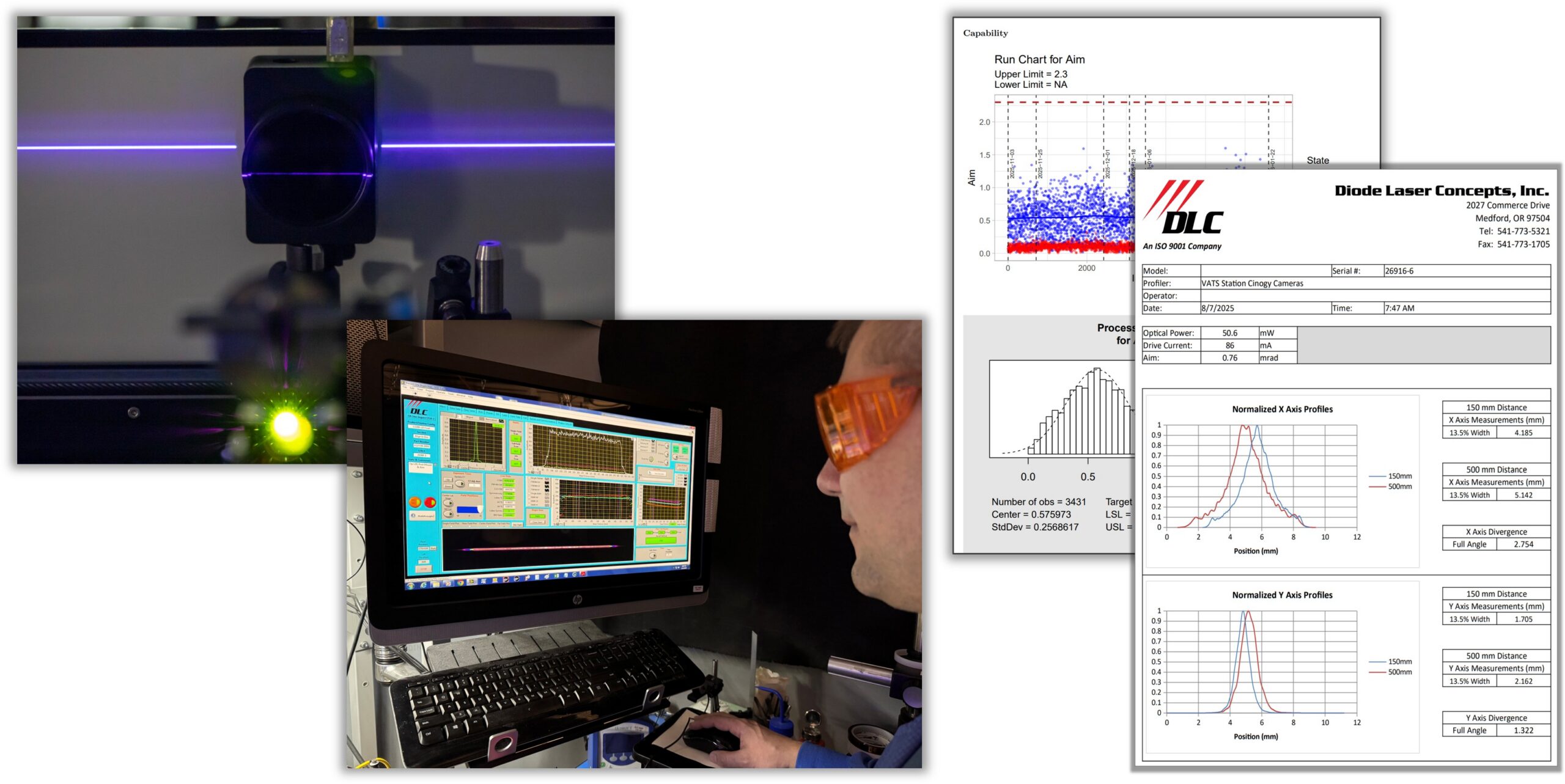
Precision optical alignment and application-specific metrology support repeatable laser performance from unit to unit.
Custom alignment fixtures and metrology developed for the application
Defined critical-to-function optical measurements
Objective optical and electro-optic performance verification
Repeatable optical-to-mechanical registration from unit to unit
Plug-and-play installation without additional field alignment
Statistical Process Control (SPC) and process capability monitoring
5. The Laser is a Critical Component of the System
A laser may begin as one component of a larger system, but its performance can become increasingly critical as the application develops. If the laser directly affects measurement accuracy, inspection results, alignment, process control, or overall system performance, its requirements may extend well beyond basic optical power and wavelength.
At this point, treating the laser as a commodity component can create unnecessary limitations. A custom laser module can be developed with the complete system in mind, including optical performance, mechanical integration, electrical control, modulation, triggering, environmental requirements, and production requirements.
The goal is to create a laser that functions as an engineered component of the customer’s system rather than as a standalone product that simply has to be made to fit.

Custom laser modules can be engineered as an integral component of the larger OEM system.
Integration of optical, mechanical, and electrical requirements
Application-specific modulation and control requirements
Custom triggering and system interfaces
Environmental and operating-condition requirements
Performance specifications developed around system-level needs
Engineering support from prototype development through production
Customizing the Laser Around the Application
A custom laser module does not necessarily mean developing every component from scratch. In many cases, proven laser sources, optics, electronics, and mechanical components can be combined and optimized to satisfy the requirements of a specific application.
The value of customization is the ability to control the characteristics that matter most to the customer’s system—whether that means achieving a specific beam geometry, fitting into a constrained mechanical package, selecting an application-specific wavelength, or establishing repeatable optical performance across production units.
For OEM and industrial applications where the laser is a critical part of the overall system, designing the laser around the application can provide a more practical path to achieving the required performance.
About DLC
Diode Laser Concepts is a custom laser solutions partner specializing in diode laser–based systems. We work alongside OEM engineering teams to solve complex laser integration challenges and deliver manufacturable, high-performance solutions. Our integrated model combines in-house engineering, prototyping, and production to support programs from early development through full-scale manufacturing.
Contact us for additional information or to discuss your specific project needs.